Prostate cancer is the most common non-skin related cancer in men. Approximately 1 out of 8 men will be diagnosed with prostate cancer in their lifetime. There are approximately 300,000 new cases diagnosed in the US each year and it is the second leading cause of cancer related death in men. Due to screening, most prostate cancers are detected early in the course of the disease and are often curable.
Risk factors
The incidence increases with age and most cancers are diagnosed in men older than 60 years
Men with a father or brother with prostate cancer are at increased risk
Men with African ancestry have increased risk
Some are related to inherited genes such as BRCA2
Diets high in red meat and fat, as well as low in fruits and vegetables may increase risk
Screening
Prostate cancer screening is most commonly performed by a physical exam using digital rectal examination (DRE), as well as a blood test measuring Prostate Specific Antigen (PSA). PSA is a protein produced by prostate cells and is normal to find in blood from males. Elevations in PSA values are common in men with benign prostate enlargement or after inflammation or infection of the prostate. Sometimes, PSA elevation may be indicative of prostate cancer.
Prostate biopsy
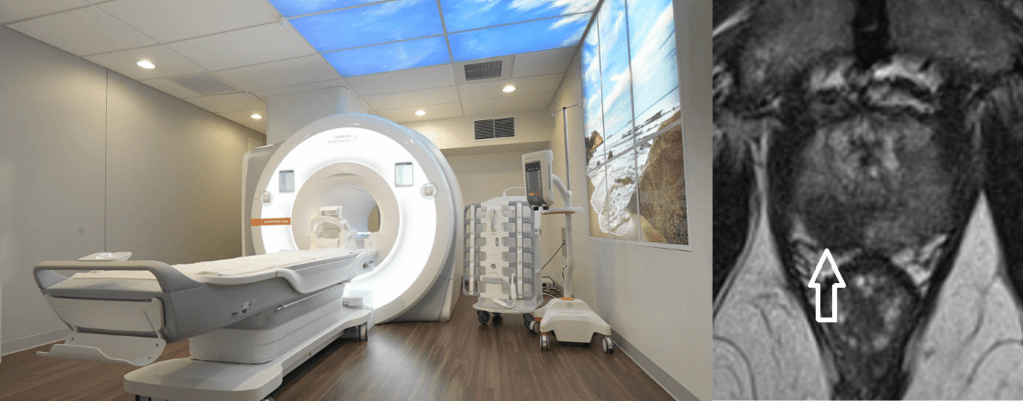
You may be recommended to have a biopsy if there is something concerning on your screening workup. Today, an MRI is typically performed prior to biopsy to look for any suspicious areas in the prostate that may require additional samples or could be missed using a traditional biopsy.
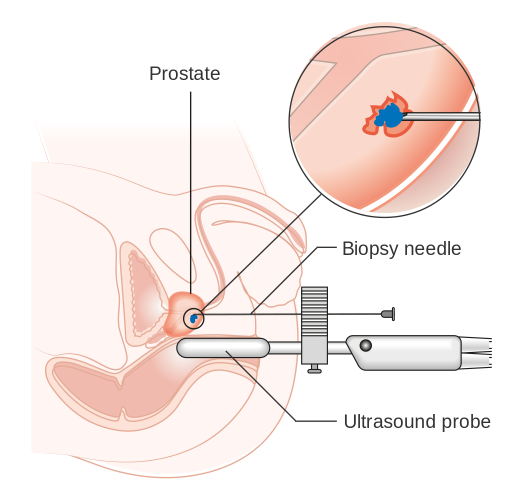
MRI images are often fused with a trans-rectal ultrasound to help guide your prostate biopsy. During the biopsy, specimens will be obtained from the prostate by passing needles through the wall of the rectum into the prostate (trans-rectal) or through the the skin between the scrotum and anus (trans-perineal). These will then be analyzed by a pathologist to determine whether any cancer is present.
Work-up/Staging
The first step after making the diagnosis of prostate cancer is to determine the extent of the disease or cancer stage. Patients are placed into risk groups based upon their stage. Traditionally, this is determined by the anatomic extent of the disease or TNM stage, the microscopic appearance of the cancer cells (Gleason group), and PSA level measured from a blood sample.
Genomic risk analysis
More recently, gene expression analyses have been incorporated into the risk assessment to determine the individual genomic risk. This is often performed using the Decipher genomic risk classifier using samples obtained from the prostate biopsy. This test looks for abnormalities in genes responsible for cellular growth and function.
The goal is to find the more aggressive prostate cancers masquerading as indolent disease.
The so-called “wolves in sheep’s clothing.”
Management
Patients with organ confined prostate cancer have several treatment options. For those with low risk disease involving limited portions of the gland, active surveillance may be considered where the disease is monitored using various measures. Usually, a biopsy is repeated after one year of active surveillance in conjunction with a prostate MRI to confirm that the disease remains low risk. If there is been disease progression or if the patient elects to proceed with active treatment, he may be considered for surgery or radiation therapy.
Surgery involves complete removal of the prostate, which is known as a radical prostatectomy, using either an open or robotic technique. During this procedure, lymph nodes around the prostate are usually sampled as well to better confirm that the cancer was confined to the prostate.
Radiation therapy is a noninvasive technique where, in its most common form, the entire prostate is treated with high-energy x-rays in order to kill the cancer cells that reside within. Recent randomized clinical trials have demonstrated equivalency between radical prostatectomy and radiation therapy in terms of cancer cure rates.
More aggressive types of prostate cancer, including those that have spread to lymph nodes, bones, or other organs will likely require the addition of systemic treatments such as hormonal therapy and/or chemotherapy.
Want to learn more?
Links
There are many great web-based resources for prostate cancer information. Here are some useful links:
Check out these videos created by Dr. David Grew, founder of PRIMR. He created a library of information about prostate and other cancers to help provide patients with a better understanding of their disease